
Hamilton County Court Record Requests
No single desk in Hamilton County holds every case file. Vince Dean, Criminal Court Clerk, keeps Criminal Court records. He also supports General Sessions Criminal. Larry L. Henry, Circuit Court Clerk, handles Circuit Court and General Sessions Civil. Rachael Kapperman, Clerk & Master, maintains the Chancery records. Juvenile Court and the municipal courts each use their own clerks.
Start with the official Hamilton County Courts map to confirm the division. If an official portal covers that court, search it online first. Then reach the right clerk. Use the phone, a visit, or whatever written route the office accepts. The county Open Records Center routes general county records. It does not replace a court clerk's own process.
- Identify the court and case number.
- Name the exact pleading, order, judgment, docket span, or recording needed.
- Choose inspection, a plain copy, or a certified copy.
- Give a narrow date range and preferred delivery method.
- Review any estimate before staff begins paid work.
Which Hamilton County Clerk Has It?
Sending a request to the wrong custodian wastes time. It can also bring back a partial answer. Criminal and Sessions Criminal files belong to the Criminal Clerk. Circuit and Sessions Civil records go to the Circuit Clerk. Other matters may sit with the Clerk & Master. These include estates, trusts, guardianships, conservatorships, tax, domestic, and equity. Juvenile records must pass the Juvenile Clerk's access review.
| Record | Likely custodian | Starting channel |
|---|---|---|
| Felony or Sessions criminal | Criminal Court Clerk | CJUS, phone, counter |
| Circuit or Sessions Civil | Circuit Court Clerk | TN Case Finder, counter |
| Chancery or probate-style | Clerk & Master | Docket page, request form |
| Juvenile | Juvenile Court Clerk | Clerk-directed access |
| City citation | Issuing city clerk | City court process |
Federal records follow a different track. The Eastern District of Tennessee relies on PACER and federal clerk procedures, not county request channels.
Kinds of Court Records
A docket is simply the chronological index of case activity. The file beneath it can be much larger: complaints, indictments, motions, responses, summonses, service papers, orders, judgments, transcripts, and exhibits. What you can actually get depends on the court. The file format and any access limits matter too. Keep this in mind. A weekly PDF or daily docket is not the whole case file.
- Docket sheets and minute entries
- Pleadings, motions, and responses
- Orders, judgments, and dispositions
- Calendars and hearing notices
- Certified or plain copies
Not every exhibit can be copied like paper. Before assuming an indexed item can be emailed, ask the clerk about format, inspection conditions, and redactions.
Hamilton County Clerk & Master Form
The Clerk & Master form asks for the requester's name and contact details. It also covers Tennessee residency, whether you want inspection or copies, delivery preference, record type, timeframe, subject matter, keywords, notes, and a signature. That layout teaches a useful lesson. Even when another clerk uses a different form, the same details make a request work.
The official request form separates inspection from duplication, and the difference matters. Inspection-only requests carry different fee treatment. Copies can be delivered several ways. Pickup, first-class mail, electronic means, or another approved method all work.
Write narrowly: A case number, document title, and date range help the custodian avoid broad paid research.
Court Records: What They Contain
Fields shift with the court and the case. A criminal file may hold counts, charge codes, bond entries, motions, trial settings, and a General Sessions number. A civil file can carry party names, filing dates, service, motions, hearing settings, and judgments. Chancery records may add motion-call and procedural-step details.
| Caption | The formal case style or party names. |
|---|---|
| Case number | The court's file key, including any prefix or cross-reference. |
| Filed document | A pleading, motion, response, notice, or other indexed item. |
| Setting | Date, time, division, courtroom, and event type. |
| Order | The judge's signed direction or ruling. |
| Disposition | The recorded outcome, which should be verified from the order. |
A status label is not always a final result. Labels like continued, settlement, compliance, and motion call describe procedural events, so ask for the signed order when the difference matters.
Copy Fees and Certification
A plain copy just reproduces the clerk's file. A certified copy adds the clerk's attestation and seal. Which one you need depends on your reason for wanting the record, and the fee depends on the custodian, page count, certification, labor, delivery, and each court's own schedule.
The Chancery rules and fees page cautions that posted amounts may not be real-time and tells readers to call 423-209-6600 for current figures.
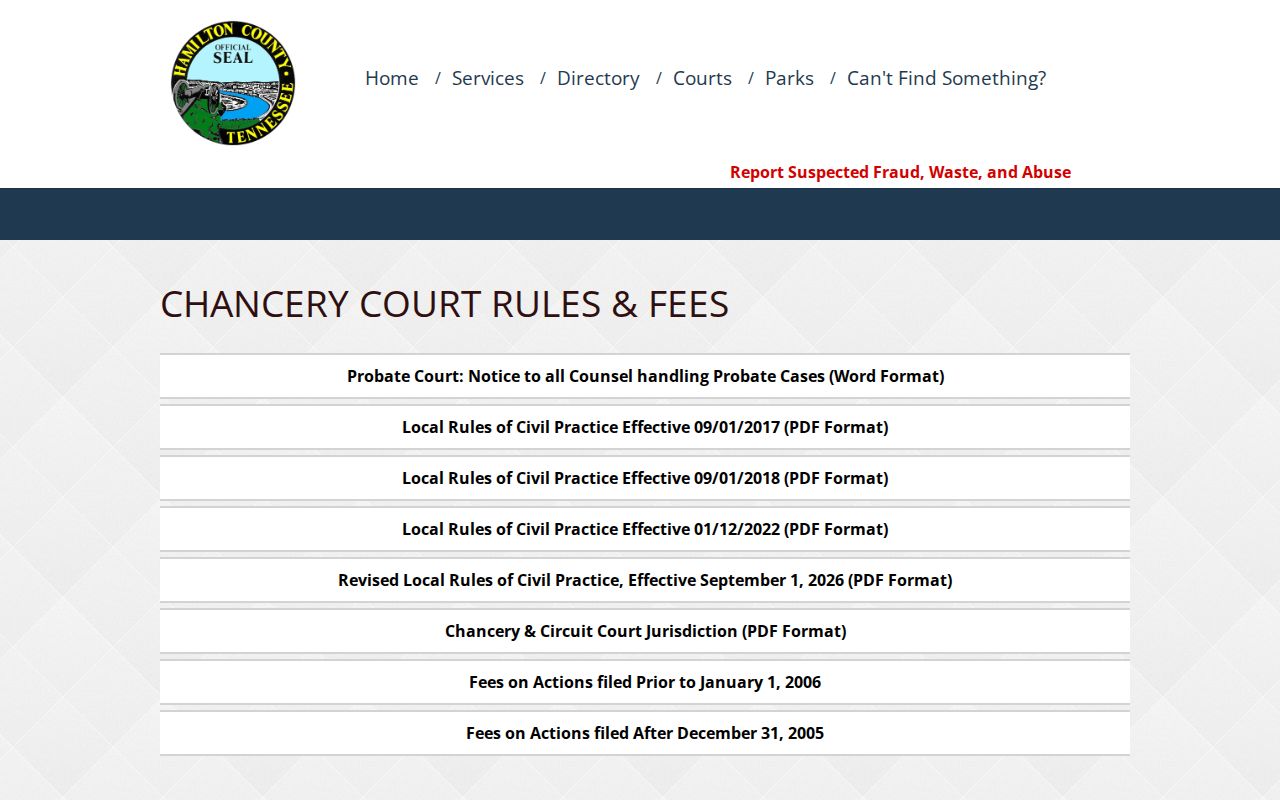
The image supports a practical rule: confirm the current total before sending payment.
| Cost factor | Why it changes |
|---|---|
| Inspection | Often differs from duplication |
| Copy pages | Paper or electronic volume |
| Certification | Clerk attestation adds a charge |
| Labor | Retrieval and redaction may apply |
| Delivery | Mail or media can add cost |
Narrow Hamilton County Requests First
Hamilton County's public-records policy allows cost estimates, labor charges, and advance payment in appropriate cases. A request for every item mentioning a name can trigger needless review. Narrow it instead. Use the known case, court, filing window, and document type. Without a case number, start with a Hamilton County docket search.
Ask whether you can inspect before choosing copies. Inspection often shows this. Only one order is truly needed. It spares you from buying pages that just repeat docket information.
Note: General county request routing does not override the court clerk's custody, sealing orders, or court-specific fee schedule.
Access Rules for Court Records
Tennessee Supreme Court Rule 34 sets the main framework for court-record access. Public access is the baseline. Sealed records, confidential material, protected information, and deliberative records stay outside it, and other statutes or court orders can impose further limits.
The official Rule 34 page appears below.
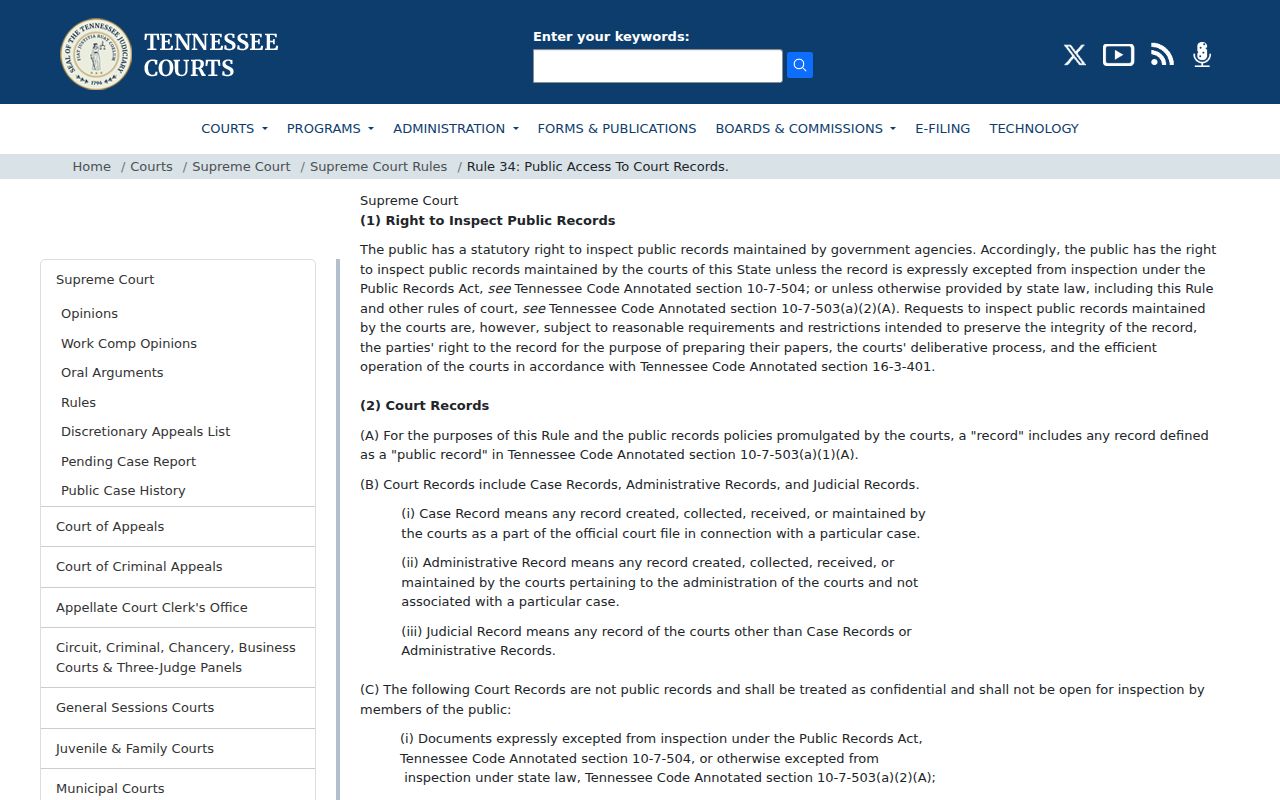
The rule also explains a common puzzle: a public docket entry can exist while its attached document stays unavailable or redacted.
Access is record-specific. A requester cannot use a county form to bypass a sealing order, juvenile confidentiality, or protected personal information.
Hamilton County Sealing and Expungement
Sealing and expungement work differently in Hamilton County. Sealing limits public access to a court record through a court order or by operation of law. Expungement is its own legal process. It can clear eligible records once the required steps are finished. So a docket label like dismissed, nolle prosequi, no true bill, or not guilty may invite a closer look at the case. It does not prove that expungement actually happened.
The Tennessee courts expungement page is the official place to start.
Call the court that entered the order to confirm its current status. A docket you downloaded earlier may not match what the Hamilton County clerk now shows.
Hamilton County Court Records Office
The Criminal Court Clerk sits at 102 Courts Building, 600 Market Street, Chattanooga, Tennessee 37402. The phone number is 423-209-7500. That office is the starting point for Criminal Court records only, not Circuit, Chancery, Juvenile, city, or federal files.
Criminal Court Clerk
Vince Dean
102 Courts Building
600 Market Street
Chattanooga, TN 37402
423-209-7500
Use the county court directory. It is the easiest way to find the right clerk for another division. Tell the office exactly what record you want. Say whether you need a certified copy. Ask them to send an estimate back before any work begins. That way your request lands with the correct Hamilton County office the first time.
A quick phone call saves a wasted trip. Ask where the file actually sits: at the counter, in an archive, or with a different division entirely. Confirm the payment methods they take. Ask about the current cost per page, the certification fee, and the office hours. For a large or older file, ask whether they want advance notice. If staff cannot settle the request by phone, request their current written submission route and mailing instructions.
Bring a case number if you have one. It speeds everything up. When inspecting a court record in person, mark the entries you want copied rather than ordering the whole file. For mail requests, include clear contact details, but hold back sensitive identity documents unless the clerk states they are required for that channel. Each step keeps your Hamilton County court records request tied to the right office.